When the Veil Thins in Tulum: Day of the Dead in the Jungle That Remembers
From October 30, Paseo Tulum becomes a corridor of altars, catrinas, and fire dancing. But the truest celebration of Dia de Muertos in Tulum is not on the beach — it is in the jungle neighborhoods where the Maya tradition of Hanal Pixan still breathes. Here is why this is the week Tulum drops its mask and remembers who it is.
When the Veil Thins in Tulum: Day of the Dead in the Jungle That Remembers
There is a week in Tulum when the town stops performing.
Not the beach clubs, which will keep their playlists going. Not the cocktail bars, which will keep their lights on. But the town itself — the real one, the one that existed before the hotels and the hashtags — steps into something older and quieter and more honest than anything a brochure could sell.
From October 30, Paseo Tulum will host five nights of Day of the Dead celebrations: altars lined along the street, catrinas painted and paraded in handmade finery, fire dancers spinning against the dark. It is the first street-level cultural event in a campaign to bring visitors back to Tulum's center — and it may be the most important thing the town has done in years.
Not because it is new. Because it is not.
Hanal Pixan: The Maya Name for What the Beach Forgot
What most of the world calls Dia de Muertos, the Maya of the Yucatan peninsula call Hanal Pixan — the food of souls. The name itself tells you everything you need to know about how this tradition works. It is not about fear. It is not about horror. It is about feeding the dead. Setting a plate. Lighting a path. Saying: we have not forgotten you, and we set this table because you are still part of this family.
In the Maya tradition, the veil between the living and the dead does not break. It thins. For a few days each year, the people you lost can find their way back — not through grief, but through the scent of cempasuchil, the orange marigold whose petals are scattered like a carpet from the road to the altar so the spirits can follow the fragrance home.
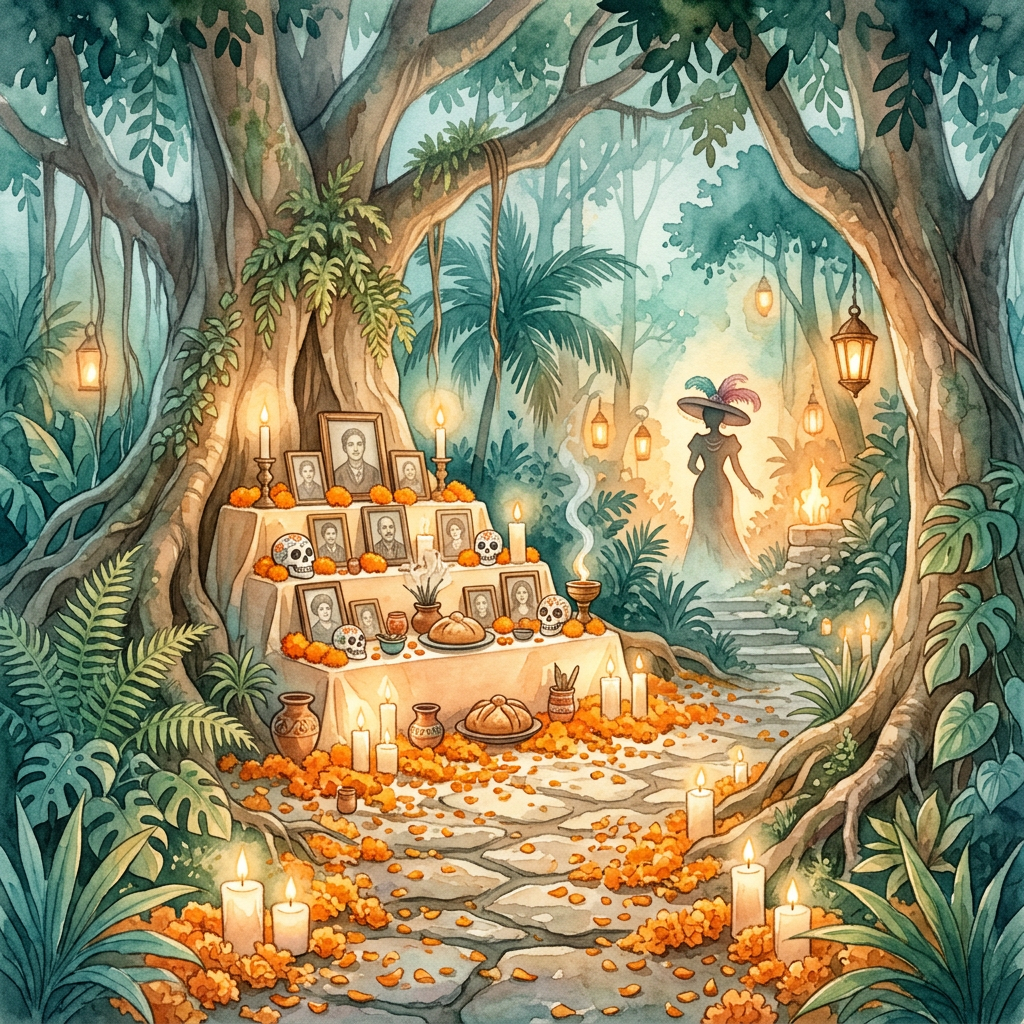
The ofrenda is the center of everything. It is not a decoration. It is a letter written in objects: the photograph of the person you are calling back, the dish they loved in life, the candle that lights their way, the salt that purifies, the water that quenches a thirst that lasts longer than a lifetime. Every element is intentional. Nothing is ornamental.
This is the tradition that lives in Tulum's neighborhoods. Not in the hotel zones, where Day of the Dead is sometimes a theme night with face paint and a margarita special. In the streets, where families build altars on their doorsteps and the whole block comes to look and to remember together.
Why the Jungle Holds the Celebration Best
Tulum's relationship with death is different from the rest of the Riviera Maya, and the reason is the jungle.
The Maya did not build Tulum on the beach. They built it in the forest, with the sea as a border and the cenotes as doorways. The civilization that named this place — the walled city, the city of dawn — understood that the boundary between worlds is not a wall but a membrane. The cenotes were not swimming holes. They were portals. The rain filtering through limestone into underground rivers was the physical proof that this world and the next are connected, always, through water and stone.
When Day of the Dead arrives in Tulum, that geography becomes part of the ritual. The altars go up under ceiba trees — the same sacred ceiba that the Maya believed held the universe together, its roots in the underworld, its branches in the heavens. The candles flicker in the same jungle air that carries the scent of cempasuchil and copal incense. The fire dancers move in the same clearing where, six months earlier, the rains came and the earth drank deep and the cenotes rose.
This is not a show. It is a geography remembering what it was built for.
Five Nights in Paseo Tulum: What to Expect
The celebrations at Paseo Tulum run from October 30 through the first days of November, overlapping with the traditional dates of November 1 (Dia de los Inocentes, when the spirits of children return) and November 2 (when the adults come home).
What you will see:
Altars along the street. Built by families, businesses, and community groups, each one tells a story. Some are simple: a photograph, a candle, a plate of pan de muerto. Others are elaborate constructions weeks in the making, with arches of marigolds, sugar skulls, and personal objects that make the ofrenda a biography in objects.
Catrinas. The elegant skeletal figures born from Jose Guadalupe Posada's etchings a century ago, now a living tradition. In Tulum, catrinas are not costumes. They are embodiments — women and men who spend hours being painted and dressed to walk the streets as a reminder that death comes for everyone, and that elegance in the face of it is the deepest form of respect.
Fire dancing. Not entertainment. Ceremony. The fire is purification, transformation, and the element that connects the earth to the sky. In the context of Day of the Dead, it is the light that guides and the warmth that welcomes.
Traditional food. Mucbil pollos — the Maya tamale pie baked underground in a pit lined with banana leaves. Pan de muerto. Xtabentun, the anise liqueur made from fermented honey. Chocolate, which the Maya called the drink of the gods and which still finds its way onto altars across the peninsula.
How to Witness It With Respect
Day of the Dead is not a spectator sport. It is an invitation, but the invitation comes with terms.
Ask before you photograph an altar. Some families welcome it. Others consider the ofrenda a private communication with the dead, and a flash from a stranger can feel like an intrusion into a conversation that is not yours.
Bring marigolds, not selfies. If you want to participate, the simplest gesture is to add a flower or a candle to a public altar. It is the equivalent of being invited to dinner and bringing wine — small, but it says you understood the assignment.
Do not call it Halloween. The two traditions share a calendar week and almost nothing else. Halloween confronts death with a mask. Day of the Dead sits with death at the table and pours it a drink.
Go slow. The celebration is not a circuit. It is a walk. The altars are meant to be seen the way you read a letter — with attention, with the willingness to sit with someone else's grief and love at the same time.
What Casa Kobaab Has Always Known
Casa Kobaab Tulum was built on the same premise that Hanal Pixan operates under: that the boundary between worlds is thinner than we think, and that the jungle is where that thinness is felt most.
Our signature experience, The Forbidden Show, is rooted in Maya mythology — a dark, immersive cultural performance that does for a small audience what Day of the Dead does for a neighborhood: it drops the performance and lets something older move through the space. Our on-site Galeria de Arte rotates works from regional and international artists whose practice engages with the same questions the ofrenda asks: what remains, what returns, what do we carry forward.
And our Harmonic Connections sound healing sessions, held in the heart of the property, work with the same understanding the Maya had about vibration as a bridge between states of being. Sound, like scent, like fire, like water moving through limestone, is how the living and the dead find each other.
To stay in La Veleta during Day of the Dead is to be inside the tradition, not adjacent to it. You walk out of your suite and into the streets where the altars stand. You come back to the jungle and the silence, and the silence is not empty. It is the other half of the conversation.
The Week Tulum Drops Its Mask
Tulum has spent years becoming a destination. It has spent centuries being something else — a place where the jungle, the water, and the dead all know each other's names.
For five nights starting October 30, that older Tulum steps forward. Not behind a paywall, not inside a VIP zone, not on a stage. In the street. Under the trees. Around the altars that families built with their own hands.
If you have been waiting for the moment to visit Tulum the way the people who live here experience it, this is it.
And if you want to sleep inside that experience — to wake up in the jungle where the ceiba stands and the cenotes breathe and the veil is at its thinnest — we will be here.
Be yourself.